Astronomers Confirm the Youngest Planet Ever Found, and It Breaks the Formation Rules
Elias 2-24 b is less than a million years old and sits 55 times farther from its star than Earth does from the sun, a combination current planet-formation models cannot fully explain.

By Sana Whitfield, Culture, Science & Life
· 4 min read · Updated
Key Takeaways
- •Andrea Bernardi of Universidad Diego Portales confirmed Elias 2-24 b, a Jupiter-size planet less than 1 million years old orbiting a star 450 light-years away, in a study published September 16, 2026, in The Astrophysical Journal Letters.
- •Elias 2-24 b beats the previous youngest-planet record held by four planets around PDS 70 and WISPIT 2, which were already estimated at more than 5 million years old.
- •The planet sits 55 times farther from its star than Earth is from the sun, a distance where core accretion models predicted formation should take longer, not less.
- •Confirmation combined 2018 and 2020 Keck Observatory coronagraph images with gap-mapping from the Atacama Large Millimeter/submillimeter Array and detections from the European Southern Observatory's Very Large Telescope.
- •Co-author Alice Zurlo cautioned the planet sits at the edge of current instrument sensitivity, and the team is planning follow-up spectroscopy to measure its mass directly.
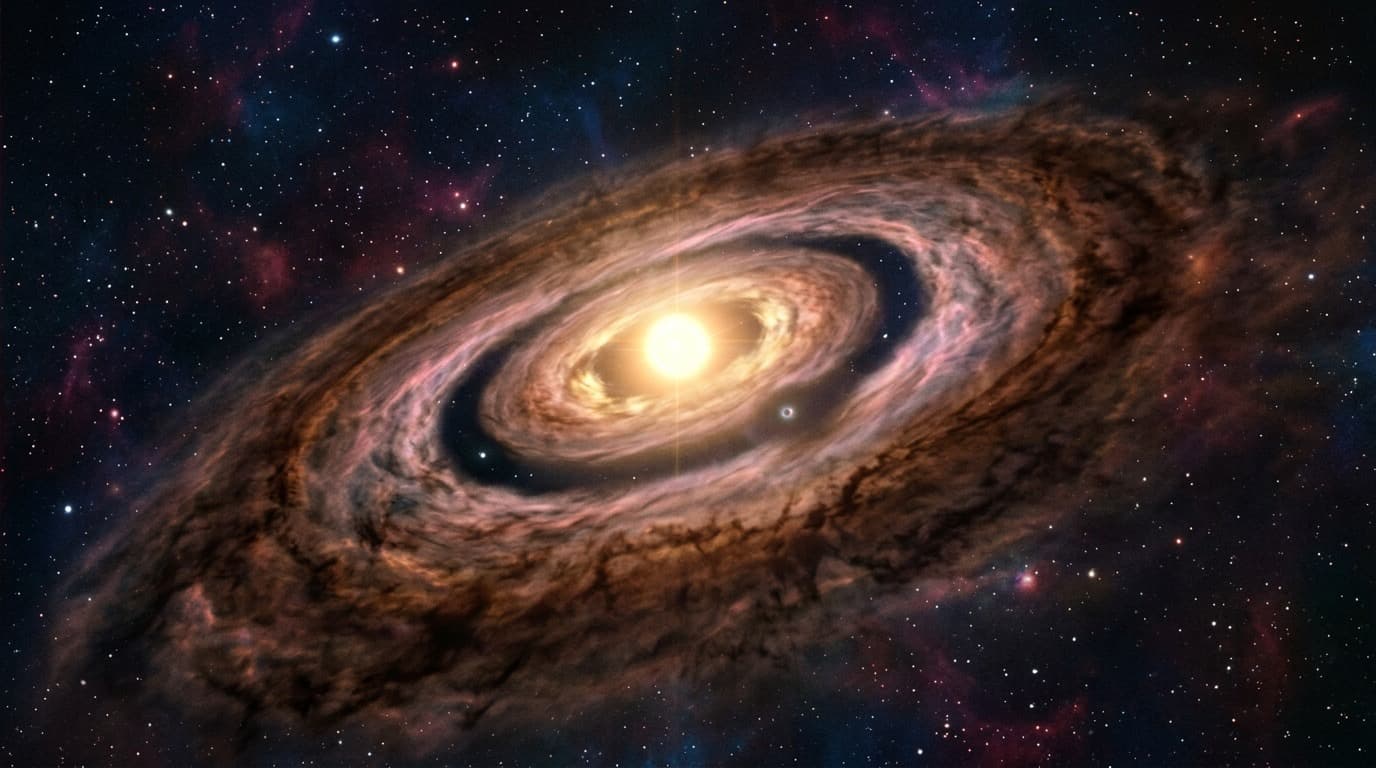
Andrea Bernardi wasn't running a new telescope when he found it. He was digging through Keck Observatory images that had sat in an archive since 2018, looking for anything the first pass might have missed. In the gap of a dust ring circling a faint young star 450 light-years away, he found a planet nobody had confirmed before: Elias 2-24 b, a world roughly the mass of Jupiter, born less than a million years ago.
That makes it the youngest planet ever directly confirmed, and by a wide margin. The four planets that held the record before it, two orbiting the star PDS 70 and two orbiting WISPIT 2, were already estimated at more than 5 million years old when astronomers spotted them. Elias 2-24 b is a fifth that age at most, and it sits much farther from its star than any of them did.
The short answer
Astronomers led by Andrea Bernardi at Universidad Diego Portales in Chile confirmed Elias 2-24 b, a Jupiter-size planet orbiting a young star 450 light-years away, as the youngest planet ever directly detected at under 1 million years old. It sits 55 times farther from its star than Earth does from the sun, a distance where current formation models predict a planet that size should take longer to build, not less. The study published September 16, 2026, in The Astrophysical Journal Letters.
A planet that shouldn't have had time
The leading theory of how giant planets form, called core accretion, has dust grains sticking together into pebbles, pebbles into boulders, and boulders eventually into a solid core heavy enough to pull in gas from the surrounding disk. At Jupiter's distance from a star, that process is estimated to take roughly 5 million years. Elias 2-24 b sits 55 times farther from its star than Earth sits from the sun, in a region where raw material is thinner and slower to clump. By the standard math, a planet that far out should take even longer to build. It didn't.
<1 million
years old, Elias 2-24 b's estimated age
Roughly a fifth the age of the previous record holders, and formed 55 times farther from its star than Earth is from the sun.
How the record fell
The planet turned up because of what was missing from the disk around it. Elias 2-24, the young star it orbits, is ringed by gas, dust, and small grains of ice and rock, the raw material of planet formation. Bernardi's team spotted a gap cut into that ring, the kind of feature a growing planet leaves as it clears a lane through the debris around it. "The planets should be found within the gaps, since they are carving them," Bernardi said. "And that's exactly where we found Elias 2-24 b."
Confirming it took three observatories working together: coronagraph images from Keck taken in 2018 and 2020, gap-mapping from the Atacama Large Millimeter/submillimeter Array, and an early faint detection from the European Southern Observatory's Very Large Telescope. John O'Meara, chief scientist at the W. M. Keck Observatory, said the underlying data had simply waited for the right tools to read it. "Astronomical data can have a remarkably long shelf life," he said. "The observations existed for years, but new techniques, improved models, and a fresh look at the data revealed something extraordinary."
The catch
Not everyone on the team is calling the case fully closed. Alice Zurlo, a co-author on the study and professor at Universidad Diego Portales who first flagged the star back in 2018, said the planet sits right at the edge of what current instruments can measure, and that theoretical models "still struggle to reliably predict its mass, entropy, and, consequently, its expected luminosity." The team is planning follow-up spectroscopy to pin down the planet's mass directly rather than relying on brightness alone, which is the more indirect method used so far.
“In a way, we're observing a much younger version of a planetary system like our own.”
Why it matters beyond one star
The find adds to a pattern moving fast in one direction: the record for youngest confirmed planet has now fallen twice in about a year, each time pushing the earliest known stage of giant-planet formation further back than modelers expected. Cieza, who worked on both this paper and research into the previous record holders, said the models built to explain those planets already came up short. "Our planet-formation models already struggled to explain the previous record holders," he said. "Elias 2-24 b shows us that even our best planet-formation models are still missing some important processes."
NASA's Nancy Grace Roman Space Telescope, which began operating August 30, 2026, is expected to scan wider patches of sky for disks with similar gaps, which could eventually turn Elias 2-24 b from an outlier into the first known member of a class. For now it stands alone: a single, roughly one-million-year-old data point that the leading theory of how planets like Jupiter form cannot yet fully explain.
- Elias 2-24 b
- exoplanets
- planet formation
- Keck Observatory
- astronomy
Sources
- 01Newfound 'Baby' Planet Smashes Record for Youngest Known World, NASA Sciencescience.nasa.gov
- 02Youngest Exoplanet Yet Discovered Found Hiding in Keck Observatory Data, W. M. Keck Observatorykeckobservatory.org
- 03Searching for Embedded Protoplanets with the Keck/NIRC2 Vortex Coronagraph: Confirmation of a Core-accretion Planet in the Narrow Gap of the Elias 2-24 Disk, The Astrophysical Journal Lettersdoi.org
Corrections
No corrections have been made to this article.

About the reporter
Culture, Science & Life Reporter, Trestlewire
I started out writing about science — real lab-coat, peer-reviewed, methods-section science — and I moved into culture coverage because I kept noticing that the internet, not the lab, is often where science actually plays out in people's daily lives now. A study on sleep or attention or habit formation used to sit in a journal for a decade before anyone outside the field read it. Now it shows up in a group chat by Thursday, usually stripped of every caveat that made it interesting in the first place.
Read full bio and all stories →