Total Solar Eclipse Sweeps Across the United States, Coast to Coast for the First Time Since 1918
MADRAS, Ore., Aug.

By Sana Whitfield, Culture, Science & Life
· 2 min read
Key takeaways
- •It is the first total solar eclipse to cross the nation since 1918.
- •Totality lasted anywhere from a few seconds to about two and a half minutes, depending on where people stood.
- •AAA urged drivers to pull over to look up, and advised against wearing eclipse glasses while driving.
- •This one went from ocean to ocean, over towns, farms and football fields, so a large part of the country could step outside and see it for itself.
The short answer
MADRAS, Ore., Aug. 21 - Millions of people looked up on Monday as the moon slid across the sun and a total solar eclipse crossed the United States from the Oregon coast to South Carolina. It is the first total solar eclipse to cross the nation since 1918. The path of totality, the narrow strip where the moon fully covers the sun, ran from Salem, Ore., to Charleston, S.C., in a band about 70 miles wide.
MADRAS, Ore., Aug. 21 - Millions of people looked up on Monday as the moon slid across the sun and a total solar eclipse crossed the United States from the Oregon coast to South Carolina.
It is the first total solar eclipse to cross the nation since 1918. The path of totality, the narrow strip where the moon fully covers the sun, ran from Salem, Ore., to Charleston, S.C., in a band about 70 miles wide. It crossed 14 states.
Totality began in Madras at 10:19 a.m. Pacific time. In Casper, Wyo., it came just before noon, local time. The shadow left the mainland near Charleston at 2:46 p.m. Eastern.
Totality lasted anywhere from a few seconds to about two and a half minutes, depending on where people stood. The longest stretches were near Carbondale, Ill., and Hopkinsville, Ky., at 2 minutes, 38 seconds. The mainland last saw any total eclipse in 1979, and only five Northwest states had total darkness then. Outside the path, a partial eclipse was visible across the entire North American continent, and also from Hawaii, Central America, the Caribbean, northern South America and western Europe. People along the path saw a partial eclipse for two to three hours.
Weather mattered in places. Clouds briefly blocked the sun in some spots, then cleared in time for most viewers. In Carbondale, where about 15,000 people had gathered in a stadium, clouds partly blocked the view for several seconds and drew boos before they parted. In Charleston, clouds from a lightning storm cleared just in time.
AAA urged drivers to pull over to look up, and advised against wearing eclipse glasses while driving. The eclipse was a rare shared moment for people in 14 states, from Oregon to South Carolina.
Why it matters: This one went from ocean to ocean, over towns, farms and football fields, so a large part of the country could step outside and see it for itself. The path crossed Oregon, Idaho, Montana, Wyoming, Nebraska, Kansas, Iowa, Missouri, Illinois, Kentucky, Tennessee, Georgia, North Carolina and South Carolina.
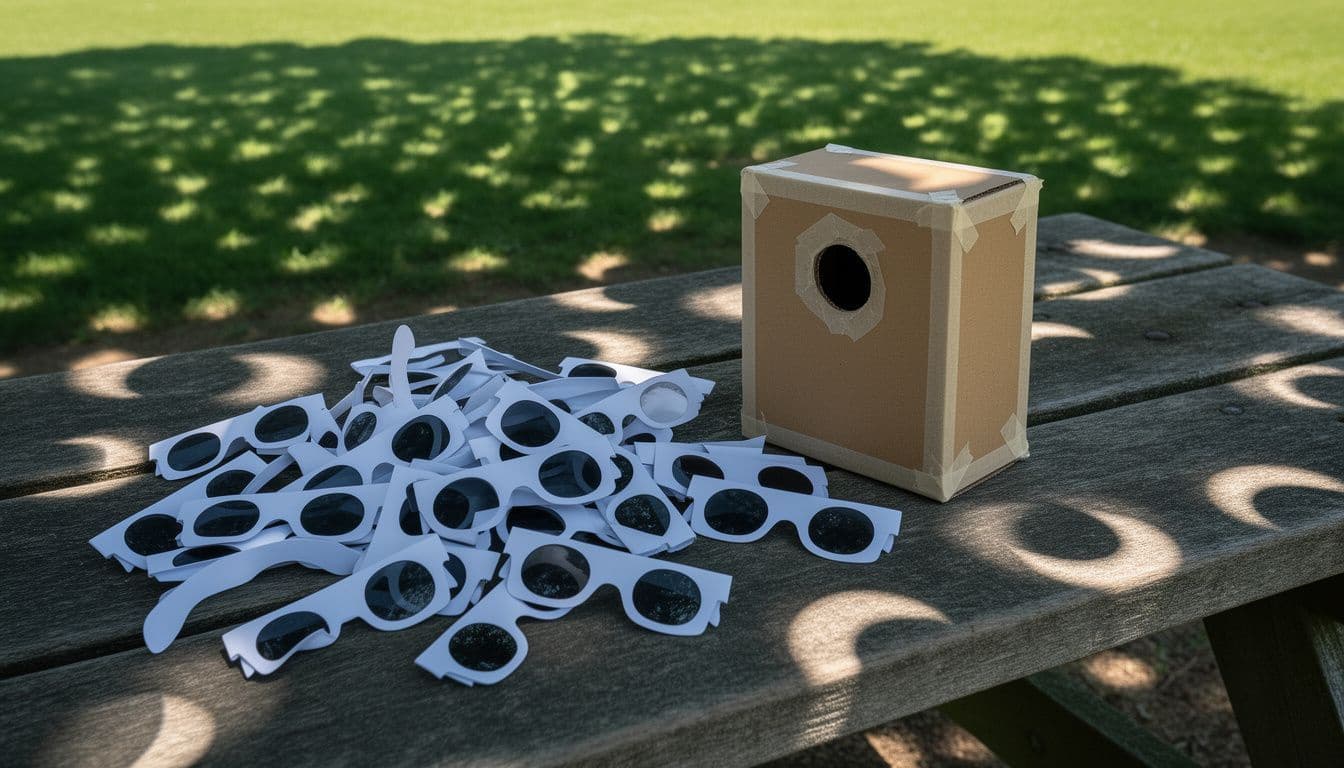
Eclipse glasses were the main safety concern. Counterfeit pairs were expected to be an eye-injury hazard.
The partial eclipse began on the Oregon coast at 9:05 a.m. Pacific time. The shadow's last stop on the mainland was Charleston.
Sources
- 01Solar eclipse hype reaches fever pitch as U.S. gets ready, NBC Newsnbcnews.com
- 022017 Total Solar Eclipse Above Madras, Oregon, NASAnasa.gov
- 03Solar eclipse of August 21, 2017, Wikipediaen.wikipedia.org
Corrections
No corrections have been made to this article.

About the reporter
Culture, Science & Life Reporter, Trestlewire
I started a science blog in 2005, back when that was a slightly embarrassing thing to admit at parties, mostly to complain about how badly sleep studies got summarized in the papers. It turned into a job. I have been writing about culture and the science of everyday life ever since, through the arrival of social media, the smartphone, the wellness boom, and roughly four hundred viral productivity hacks.
Read full bio and all stories →The Morning Wire
The day’s reporting, in your inbox before nine.
Free. Unsubscribe any time. We never share your address.