Scientists Found a Hidden Immune Organ Inside the Skull, and It Fights Brain Cancer
A Washington University team discovered lymph node-like hubs in mouse skull bone marrow that respond to brain tumors faster than the body's regular lymph nodes, and found early evidence the same structures exist in humans.

By Sana Whitfield, Culture, Science & Life
· 3 min read · Updated
Key Takeaways
- •A team at Washington University School of Medicine in St. Louis, led by senior author Jonathan Kipnis, found lymph node-like immune hubs inside mouse skull bone marrow, published in Nature on August 19, 2026.
- •Disrupting the skull immune hubs sped up tumor growth and lowered survival in mice with glioblastoma; boosting them with three immune-stimulating proteins in a scalp gel improved tumor rejection and survival.
- •First author Jang Hyun Park found similar lymph node-like structures in human skull bone marrow, though the therapy itself has been tested only in mice so far.
- •The team named Alzheimer's disease, Parkinson's disease, schizophrenia, and long COVID as conditions with a suspected immune component the discovery could eventually inform.
- •Park is starting his own lab at the Korea Advanced Institute of Science and Technology to continue the research.
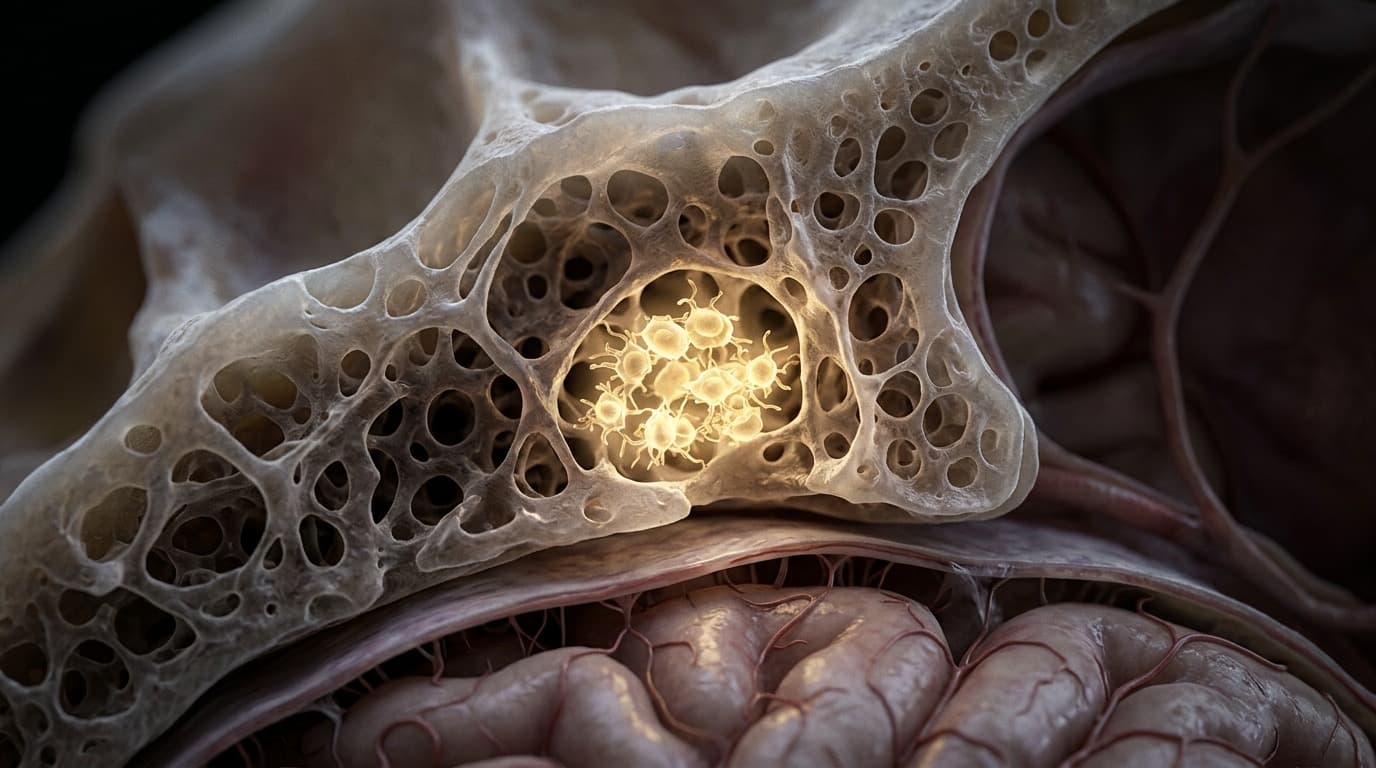
Jang Hyun Park was looking at slides of mouse bone marrow scraped from the inside of the skull when he saw something that didn't belong there: pockets of tissue organized like miniature lymph nodes, complete with the T and B cells lymph nodes use to mount an immune response. Nobody had described anything like it inside healthy bone marrow before.
Park, a postdoctoral researcher in immunologist Jonathan Kipnis's lab at Washington University School of Medicine in St. Louis, had found what the team is now calling a hidden immune organ: hubs inside skull bone marrow positioned to respond to trouble in the brain faster than the lymph nodes in the neck that normally handle the job.
The short answer
Researchers at Washington University School of Medicine found lymph node-like immune structures inside mouse skull bone marrow that act as first responders against brain cancer, ahead of the body's distant lymph nodes. Disrupting the hubs let tumors grow faster and cut survival in mice with glioblastoma. Boosting them with immune-stimulating proteins improved tumor control. Similar cells turned up in human skull bone marrow, though the therapy itself has only been tested in mice so far.
How the hubs work as first responders
The team tested the hubs using glioblastoma, one of the most aggressive brain cancers, in mice. When researchers used a drug to disrupt the skull immune hubs, tumors grew faster and the mice's survival dropped, evidence that the brain leans on these local centers rather than waiting for a signal to travel all the way to distant lymph nodes. When researchers instead delivered a mix of three immune-boosting proteins in a gel applied under the scalp, the skull hubs mounted a stronger response, and the mice rejected their tumors more effectively and lived longer.
“We have never seen such structures in healthy bone marrow before. It is an exciting discovery that points out that a complex brain requires its own specialized immune structures to defend it.”
Why the location matters
The skull sits closer to the brain than any lymph node in the neck, and the team found physical channels connecting skull marrow directly to the dura and brain tissue. Kipnis, the study's senior author, said the discovery changes how researchers think about the relationship between the immune system and the brain. "Uncovering this localized immune niche changes how we view neuroimmune interactions and opens exciting new avenues for treating brain tumors and other neurological diseases," he said.
4
conditions the team named as possible future targets
Alzheimer's disease, Parkinson's disease, schizophrenia, and long COVID, all conditions with a suspected immune component, according to the study team.
What's still unproven
The therapy has only been tested in mice, and the jump from a mouse immune system to a human one is one of the more common places cancer research stalls. The team did find evidence of similar lymph node-like structures in human skull bone marrow, but that was an observation, not a test of whether boosting those structures would help a person with glioblastoma the way it helped the mice. A trial in people is still ahead of this work, not something the study itself establishes.
Where the research goes next
Park is starting his own lab at the Korea Advanced Institute of Science and Technology, extending the research into the same hubs' role in other brain disorders the team flagged as possible next targets. The study, published August 19, 2026, in Nature, reframes a bone most people think of as passive armor. Brains have long been treated as partly walled off from the body's immune system by design, the blood-brain barrier being the clearest example. This team found an immune organ hiding in the bone around it, a shift in the map, not yet a proven treatment.
- brain cancer
- immunology
- glioblastoma
- Washington University School of Medicine
- neuroscience
Sources
- 01Newly found 'immune organ' inside skull directs brain defense, Washington University School of Medicinemedicine.washu.edu
- 02Hidden 'immune organ' in the skull may help fight brain cancer, ScienceDailysciencedaily.com
- 03Peer-reviewed study, DOI 10.1038/s41586-026-10951-4, Naturedoi.org
Corrections
No corrections have been made to this article.

About the reporter
Culture, Science & Life Reporter, Trestlewire
I started out writing about science — real lab-coat, peer-reviewed, methods-section science — and I moved into culture coverage because I kept noticing that the internet, not the lab, is often where science actually plays out in people's daily lives now. A study on sleep or attention or habit formation used to sit in a journal for a decade before anyone outside the field read it. Now it shows up in a group chat by Thursday, usually stripped of every caveat that made it interesting in the first place.
Read full bio and all stories →