Google Says Its Quantum Chip Beat the Best Supercomputer, and IBM Says Not So Fast
MOUNTAIN VIEW, Calif., Oct.

The essentials
- •Quantum supremacy is the point at which a quantum machine does a task that no classical computer can do in a practical amount of time.
- •At a news conference, Google's John Martinis said "this experiment is about building the most powerful quantum computer in the world right now." Hartmut Neven, an engineering director at Google, said the result came from "years of research and the dedication of many people."
- •IBM has not run that simulation on a supercomputer, which leaves the question open.
- •An earlier version of Google's paper was posted by mistake on a NASA website in September and was quickly removed.
The short answer
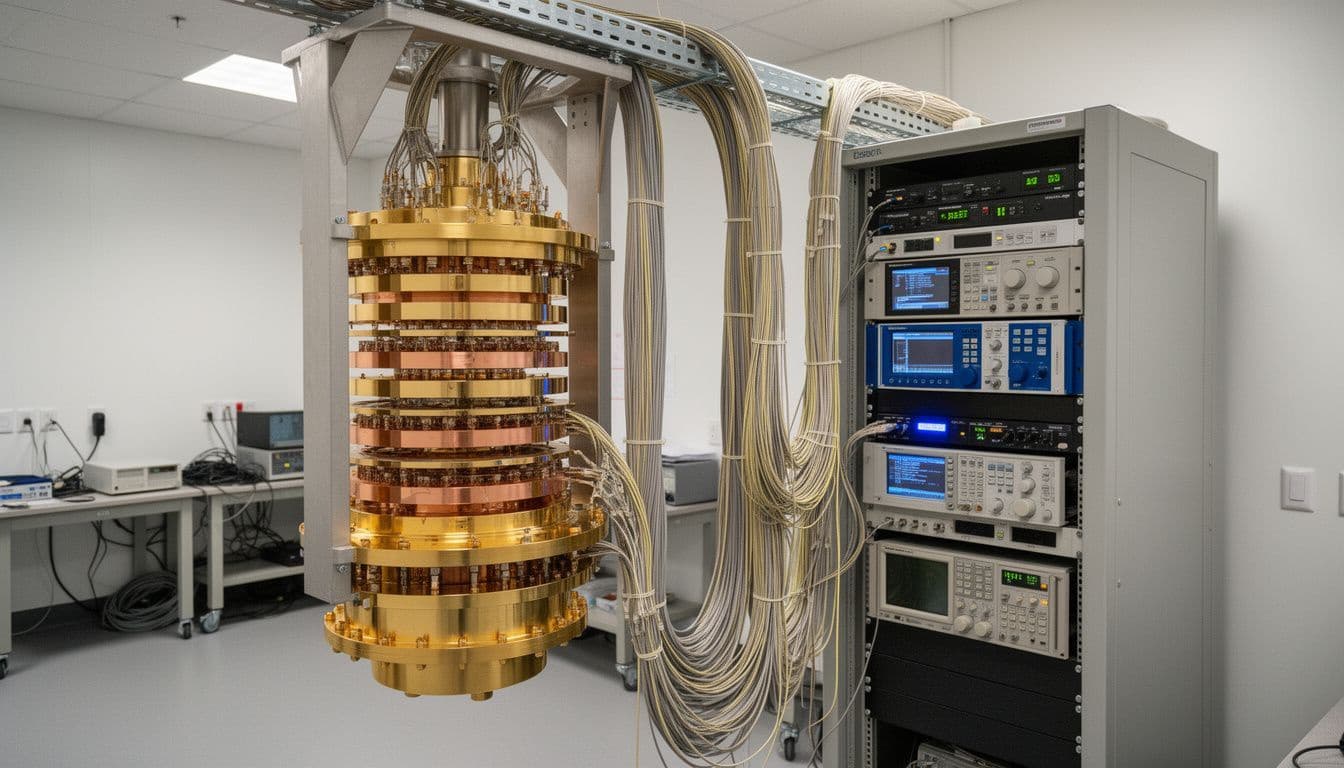
MOUNTAIN VIEW, Calif., Oct. 23 - Google said Wednesday that a quantum processor called Sycamore has reached "quantum supremacy," completing a calculation in about 200 seconds that the company says would take the world's fastest supercomputer about 10,000 years. The result is published today in the journal Nature. Quantum supremacy is the point at which a quantum machine does a task that no classical computer can do in a practical amount of time.
MOUNTAIN VIEW, Calif., Oct. 23 - Google said Wednesday that a quantum processor called Sycamore has reached "quantum supremacy," completing a calculation in about 200 seconds that the company says would take the world's fastest supercomputer about 10,000 years. The result is published today in the journal Nature.
Quantum supremacy is the point at which a quantum machine does a task that no classical computer can do in a practical amount of time. The idea was proposed in 2012 by John Preskill of Caltech.
The chip uses 53 working qubits. Google's team had 54 on the device, but one malfunctioned and was left out. Qubits can hold a mix of 0 and 1 at once, unlike the bits in an ordinary computer, and the chip must be cooled to near absolute zero.
The task was random circuit sampling. Researchers ran a series of random operations on the qubits, measured the result, and repeated the process one million times. That is a test built to favor a quantum machine. It has no practical use on its own.
At a news conference, Google's John Martinis said "this experiment is about building the most powerful quantum computer in the world right now." Hartmut Neven, an engineering director at Google, said the result came from "years of research and the dedication of many people."
IBM disagrees. On Monday its researchers posted a paper to the arXiv preprint server and a blog post arguing that the same calculation could run on a classical machine in about 2.5 days, using an improved method and a lot of hard drive storage. That would still need the most powerful supercomputer in existence. "If quantum supremacy means doing something classical computers can't, this isn't it," the IBM researchers wrote.
IBM has not run that simulation on a supercomputer, which leaves the question open. IBM also prefers a different yardstick, called quantum volume, which accounts for error rates and how long qubits hold their state.
An earlier version of Google's paper was posted by mistake on a NASA website in September and was quickly removed.
Why it matters: Quantum computers are meant to someday handle problems in chemistry, materials and cryptography that stretch today's machines. Google, IBM, Microsoft and Rigetti Computing are all racing to build bigger ones. A clean win would be a milestone, but a contested one tells researchers how much work remains, since this chip does one narrow job.
Other labs will now try to reproduce or beat both sets of numbers.
Sources
- 01Google claims to achieve quantum supremacy, IBM pushes back, NPRnpr.org
- 02Google officially lays claim to quantum supremacy, Science Newssciencenews.org
- 03Google Says Quantum Computer Beat 10,000-Year Task in Minutes, Data Center Knowledge (Bloomberg)datacenterknowledge.com
- 04Quantum supremacy, Wikipediaen.wikipedia.org
Corrections
No corrections have been made to this article.

About the reporter
Technology Reporter, Trestlewire
My first published story, in the spring of 2004, was about a database company whose new release had been announced three separate times. I knew it had been announced three times because I had signed off on two of the announcements. I spent seven years as a product manager in enterprise software before I switched sides, and the habit that came with me is a single question: does this ship, or is it a demo.
Read full bio and all stories →The Morning Wire
The day’s reporting, in your inbox before nine.
Free. Unsubscribe any time. We never share your address.