Data-Center Spending Overtook Home Building for the First Time in Q2
Real spending on data centers and other information-processing equipment hit 752 billion dollars in the second quarter, edging past the 748 billion spent on housing, the first time that has happened in a series the government has tracked since the early 1950s.

By Priya Kanth, Business & Economy
· 3 min read · Updated
Key Takeaways
- •Real spending on data centers and information-processing equipment hit $752 billion in the second quarter of 2026, edging past the $748 billion spent on residential investment, according to Fortune's analysis of Commerce Department data.
- •Information-processing investment is up 51 percent from its recent low while residential investment remains 18 percent below its early 2021 peak, with the 30-year mortgage rate near 7 percent.
- •U.S. housing starts fell 2.6 percent in August to a seasonally adjusted annual rate of 1.275 million, the Census Bureau reported September 17.
- •S&P Global Ratings projects combined capital spending by six hyperscalers, including Alphabet, Amazon and Microsoft, will exceed $1.3 trillion in 2027, up from a projected $870 billion this year.
- •S&P Global Ratings expects all six hyperscalers to post negative free operating cash flow through 2027, with recovery not projected until 2029.
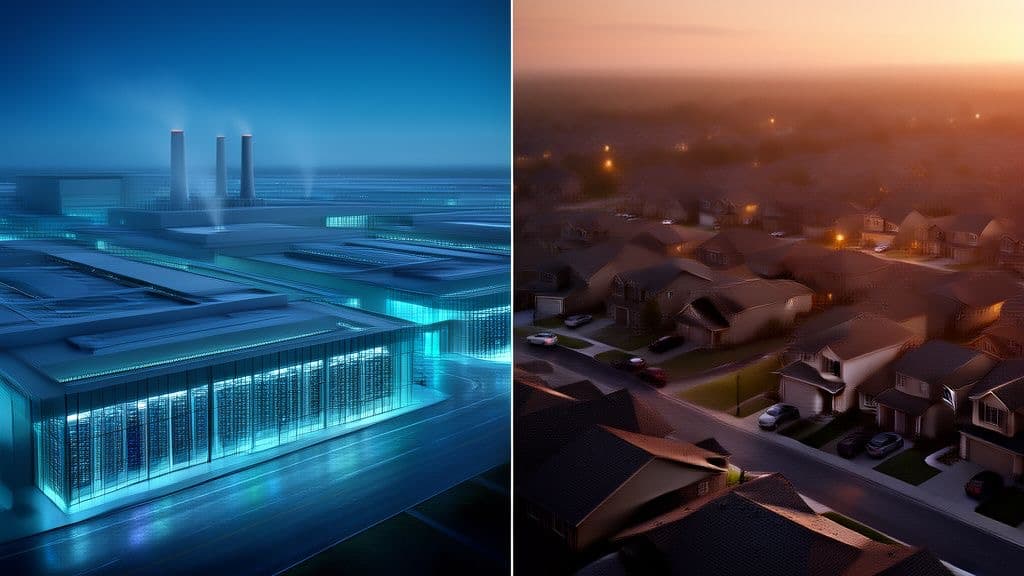
Real spending on data centers and other information-processing equipment reached $752 billion in the second quarter of 2026, according to Fortune's analysis of Commerce Department data. That edged past the $748 billion the country spent on residential investment in the same quarter, the first time information-processing investment has outspent housing in a series the government has tracked since the early 1950s.
What this means for you
For the first time in the government's national accounts, the country now spends more building data centers and buying computing hardware than it spends building and renovating homes. That is one reason new home construction stayed tight in August even as billions poured into AI infrastructure: capital that once might have financed homebuilding is now financing server farms instead.
The information-processing category is up 51 percent from its recent low, driven largely by hyperscalers building out AI computing capacity. Residential investment sits 18 percent below its early 2021 peak, held down by a 30-year mortgage rate near 7 percent.
$752 billion
real Q2 2026 information-processing investment
About $4 billion more than the $748 billion spent on residential investment, per Fortune's analysis of Bureau of Economic Analysis data.
Why home building lost ground
The Census Bureau reported on September 17 that privately owned housing starts fell 2.6 percent in August to a seasonally adjusted annual rate of 1.275 million, 1.2 percent below year-ago levels. Building permits, a forward-looking gauge of construction plans, fell 2.7 percent from July to 1.394 million.
“Investment is shifting away from residential investment and towards computers.”
The other side of the ledger
The AI buildout financing this shift is not cheap and not obviously stable. S&P Global Ratings said on August 27 that combined capital spending by six hyperscalers, Alphabet, Amazon, Microsoft, Meta, Oracle and SpaceX, will exceed $1.3 trillion in 2027, up from a projected $870 billion this year and $470 billion in 2025. The ratings firm expects all six companies to post negative free operating cash flow through 2027, with recovery not projected until 2029.
“As AI infrastructure investment accelerates, the focus is expanding beyond the scale of spending to the funding models, financial commitments and long-term implications that accompany it.”
That financing runs through debt issuance, equity sales, lease commitments, joint ventures and special purpose vehicles, structures that can keep spending off a company's core balance sheet without making the underlying obligation disappear. S&P Global named overcapacity as a real risk if AI demand does not match the buildout, and set 2028 as the year it expects revenue growth and capital spending to come back into balance. That is a forecast, not a confirmed outcome, and the same firm flagging the risk is also the one rating the debt that carries it.
The near-term winners are chipmakers, data-center builders and the construction crews working on server farms instead of subdivisions. The near-term losers include homebuyers facing a market where starts are still below last year's pace, and, if S&P's cash-flow numbers hold, whichever bondholders and equity investors are financing hyperscaler debt through 2027. Whether this quarter's number marks a new normal or a peak the accounts revise away in a few years depends on whether AI spending turns into AI revenue on the timeline the industry is promising.
- data centers
- AI infrastructure spending
- housing market
- S&P Global Ratings
- Bureau of Economic Analysis
- hyperscalers
Sources
- 01U.S. economy hits pivotal milestone: Spending on data centers and other information-processing hardware now exceeds housing investment, Fortunefortune.com
- 02AI Infrastructure Investment To Exceed $1.3 Trillion By 2027, S&P Global Ratings Says, S&P Global Ratingspress.spglobal.com
- 03New Residential Construction, August 2026, U.S. Census Bureaucensus.gov
Corrections
No corrections have been made to this article.

About the reporter
Business & Economy Reporter, Trestlewire
Before I was a journalist, I spent five years as an equity research analyst, building spreadsheet models that nobody outside a trading floor would ever see. I learned two things in those years: that a compelling story and an accurate one are not always the same thing, and that almost every business narrative worth writing about is sitting inside a spreadsheet somewhere, waiting for someone to open the file.
Read full bio and all stories →