Diesel Hits a Record $6.43 a Gallon as the Strait of Hormuz Stays Shut
The nationwide average broke a four-year-old high on September 18, gasoline is up $1.53 since the Iran war began, and Bank of America says a durable deal before the midterms is unlikely.

By Priya Kanth, Business & Economy
· 3 min read · Updated
Key Takeaways
- •Diesel averaged $6.43 a gallon nationwide on September 18, 2026, breaking the prior record of $5.81 set in June 2022 after Russia's invasion of Ukraine.
- •Regular gasoline reached $4.47 a gallon, up $1.53 since the U.S. and Israel struck Iran in February and shut down most shipping through the Strait of Hormuz.
- •The National Energy Assistance Directors Association projects heating oil bills will run more than 31 percent higher this winter.
- •Bank of America's baseline forecast of $83-a-barrel Brent crude for the second half of 2026 sits well below the roughly $103 it traded at on September 18, and the bank says prices could reach $150 if oil infrastructure is struck.
- •Fed Chair Kevin Warsh, confirmed 54-45 in May, raised interest rates Wednesday for the first time since 2023 to keep fuel-driven inflation from broadening, not to lower oil prices directly.
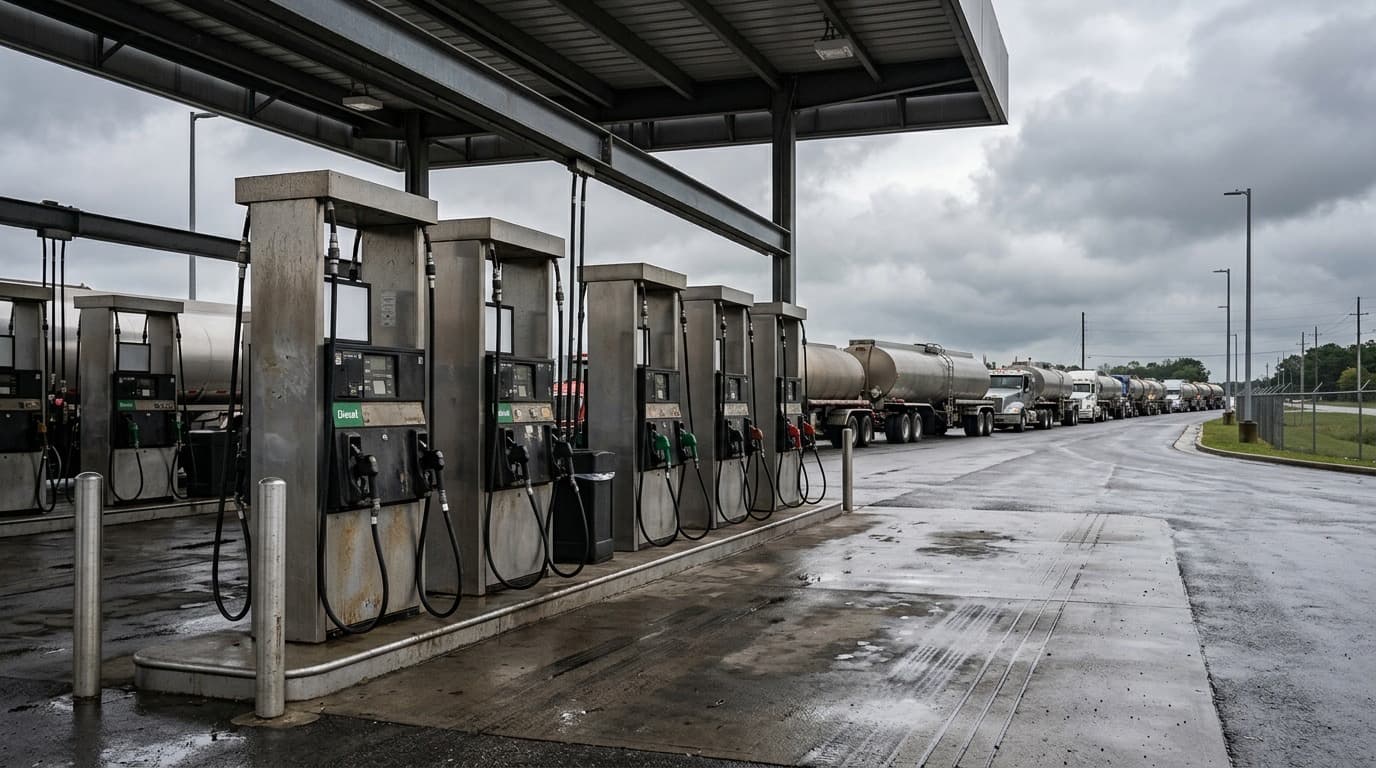
Diesel averaged $6.43 a gallon at U.S. pumps on September 18, 2026, the highest price on record and about 62 cents above the previous high of $5.81 set in June 2022 after Russia invaded Ukraine, according to data reported by ABC News. The price has climbed for weeks since the United States and Israel struck Iran in February, an attack that shut down most tanker traffic through the Strait of Hormuz, the waterway that once carried a fifth of the world's oil supply.
The short answer
Diesel hit a record $6.43 a gallon on September 18, 2026, and regular gasoline reached $4.47, up $1.53 since the U.S.-Israel war with Iran began in February. The Strait of Hormuz remains largely closed to tankers. Bank of America told clients a durable resolution before November's midterms is unlikely, and heating oil bills are projected 31 percent higher this winter.
$6.43
average U.S. diesel price per gallon, Sept. 18, 2026
Up from the prior record of $5.81 set in June 2022 after Russia's invasion of Ukraine.
Regular gasoline reached $4.47 a gallon the same day, up $1.53 since the war began, according to GasBuddy data cited by ABC News. Iranian-backed Houthi forces have hit Saudi Arabian oil facilities, the U.S. military has struck five Iranian tankers, and Ukraine has intensified long-range strikes on Russian refineries, according to Fortune. Brent crude, the global benchmark, has held above $100 a barrel since September 9, when it jumped nearly 3 percent in a single session to $100.72. It traded around $103 on September 18.
Why the pain shows up on every shelf, not just at the pump
Since diesel moves the trucks that move nearly everything else, the increase does not stop at the pump. Wholesalers facing higher fuel bills tend to raise prices to retailers, who pass some of that along to shoppers. The effect shows up gradually, item by item, rather than all at once.
What forecasters actually disagree about
Forecasters do not agree on how far this goes. Bank of America's baseline still calls for Brent to average $83 a barrel in the second half of 2026, a price well below where it is trading now. But the bank's own research note lays out how shaky that baseline is: prices could hold between $95 and $120 if the attacks continue at the current pace, and spike as high as $150 if a strike takes out major oil infrastructure. Reaching a durable deal before the U.S. midterm elections is "increasingly unlikely," Bank of America analysts wrote in the note, cited by Fortune.
Households that heat with oil face the sharpest hit. The National Energy Assistance Directors Association projected in a report this month that heating oil bills will run more than 31 percent higher than last winter. Even homes that do not use oil heat should expect overall winter heating costs to rise more than 8.7 percent, the group said.
The Fed's narrow lane
The Federal Reserve raised interest rates on Wednesday for the first time since 2023, an attempt to keep the fuel spike from spreading into the broader economy rather than a fix for the spike itself. Annual inflation stood at 3.4 percent in August, more than a full point above the Fed's 2 percent target. Fed Chair Kevin Warsh, confirmed by the Senate 54-45 mostly along party lines in May and now replacing Jerome Powell, who had led the central bank since 2018, according to NPR, told reporters Wednesday that rate policy cannot touch the price of oil directly.
“We cannot affect any individual price, whether it be oil prices, whether it be food stuffs at the grocery store. But what we can do, and will do, is ensure that any change in relative prices don't broaden out.”
That distinction matters for anyone expecting the Fed to bring diesel prices down. It will not, and Warsh did not claim otherwise. The tool he controls works on demand, not on tankers stuck outside the Strait of Hormuz. Whether diesel keeps climbing from here depends on a war the Fed has no vote in.
- diesel prices
- oil prices
- Strait of Hormuz
- Kevin Warsh
- Federal Reserve
- inflation
- Iran war
Sources
- 01Diesel prices at record highs amid Strait of Hormuz disruption, Russia-Ukraine war, ABC Newsabcnews.com
- 02Oil surges back above $100 a barrel as diesel climbs to a record $5.94 per gallon, Fortunefortune.com
- 03Senate confirms Kevin Warsh as next chair of the Federal Reserve, NPRnpr.org
Corrections
No corrections have been made to this article.

About the reporter
Business & Economy Reporter, Trestlewire
Before I was a journalist, I spent five years as an equity research analyst, building spreadsheet models that nobody outside a trading floor would ever see. I learned two things in those years: that a compelling story and an accurate one are not always the same thing, and that almost every business narrative worth writing about is sitting inside a spreadsheet somewhere, waiting for someone to open the file.
Read full bio and all stories →