Two Matched Meals Drew Different Insulin Responses. Total Blood Sugar Did Not Differ.
A Virginia Tech crossover study of 32 adults found a larger insulin response after the ultra-processed meal. It measured one 300-calorie meal in young, healthy people, not weight or disease.

By Eli Okafor, Health & Wellness
· 5 min read · Updated
Key Takeaways
- •In a randomized crossover study published October 5, 2026 in Nature Metabolism, 32 adults had a larger insulin response after an ultra-processed 300-calorie meal than after a matched minimally processed one (P < 0.001).
- •Blood glucose totals did not differ between the two meals (P = 0.92), and willingness to pay for the foods did not differ either (P = 0.34).
- •The study measured one meal in healthy adults with a mean age of 26 and a mean BMI of 22.75, and did not measure weight, eating or disease.
- •The brain-imaging link is thin: the left ventral striatum result had a corrected P of 0.045, just under the 0.05 threshold.
- •A 2019 NIH trial of 20 adults found about 508 more calories eaten per day on an ultra-processed diet, a result the new study did not test.
What is actually known about ultra-processed food comes mostly from observational data. People who eat more of it have higher rates of obesity, type 2 diabetes and cardiac events. Those studies cannot separate the processing from the sugar, fat and low fiber that usually come with it. The foods supply about 55 percent of calories for the average American, according to the paper. A study published October 5 in Nature Metabolism held the ingredients constant and changed only the processing, using a single meal.
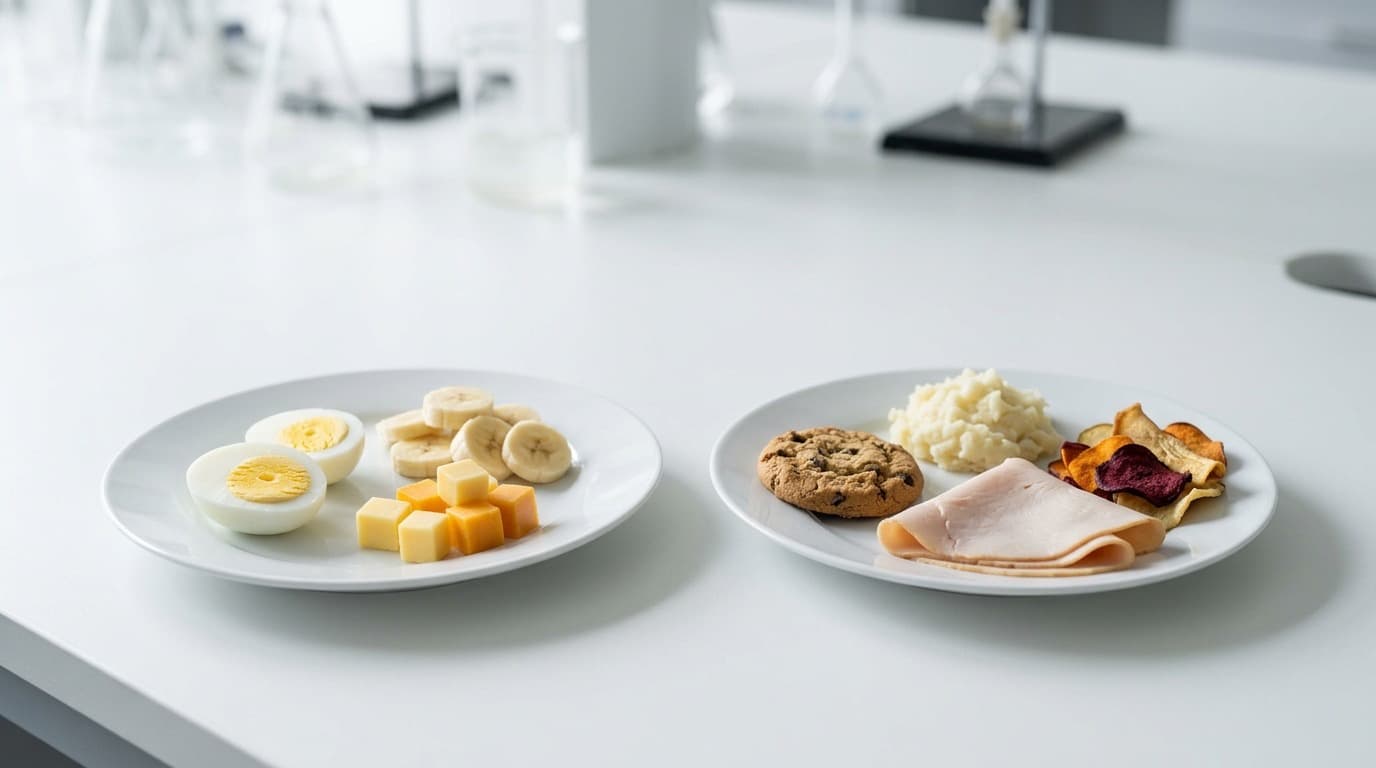
The team, led by neuroscientist Alexandra DiFeliceantonio at Virginia Tech's Fralin Biomedical Research Institute in Roanoke, built two meals of about 300 calories each. The minimally processed one was a hard-boiled egg, sliced banana, dried cranberries and cheese. The ultra-processed one, classified under the Nova system, was deli turkey, instant mashed potatoes, a cookie, cereal, veggie chips and a bite of sandwich. According to the paper, the two matched on weight, energy, macronutrients, glycemic index, fiber, sodium and water, with no measure more than 1.6 percent apart.
Four hours in a metabolic chamber
Thirty-two adults completed both metabolic sessions, in random order and at least three days apart. Each arrived after an overnight fast and lay on a twin-size bed inside a sealed whole-room calorimeter with an IV catheter in place. They had 10 minutes to finish the meal. Blood was drawn eight times over four hours while the room tracked energy use and fuel burning.
32 of 57
enrolled adults who completed both metabolic sessions
Insulin data came from 31 of them. The brain imaging session covered 52.
Blood glucose totals did not differ between the meals (P = 0.92). Insulin did. Total insulin exposure was larger after the ultra-processed meal (P < 0.001). The gap opened at 40 minutes, held through 120 and closed by 180, when both conditions were near baseline. The processed meal also produced a higher metabolic rate (P = 0.02) and a different fuel mix: less carbohydrate burned, more fat burned.
“We were shocked when every single metabolic metric differed.”
Not every metric moved. Glucose totals matched, and so did ratings of how much participants liked or wanted each meal. Hunger and fullness ratings did not change differently over time between conditions either.
Where the summary runs ahead of the data
In the university's release, Hutelin said blood sugar stays a little higher for a little longer after the processed meal. The paper's own numbers are more modest. Glucose rose faster after the whole-food meal, with higher values at 20 minutes (corrected P = 0.02). Later, glucose was described only as trending higher after the processed meal at 120 and 180 minutes. The total area under the curve showed no difference. The evidence supports an insulin difference. A lingering glucose difference remains a trend.
The brain result is the thinnest part
Fifty-two participants completed an fMRI session on a separate day, viewing 28 food pictures and bidding between $0 and $5 for each. Bids did not differ between processed and minimally processed foods (P = 0.34). The reported link was indirect. The size of the difference in carbohydrate burning tracked with the difference in striatal response, a reward region, to whole-food versus processed pictures. Within a region chosen in advance, the caudate result had a corrected P of 0.007 and the left ventral striatum 0.045, just under the usual 0.05 line. The evidence is thin, it comes from a subset of participants, and it has not been replicated.
What the 2019 NIH trial measured instead
The nearest comparison is a 2019 inpatient trial from Kevin Hall's group at the NIH, published in Cell Metabolism. Twenty adults spent two weeks on each of two diets matched for presented calories, sugar, fat, fiber and sodium. On the ultra-processed diet they ate about 508 more calories a day and gained roughly 2 pounds. On the unprocessed diet they lost about 2. That trial measured eating and weight. The Virginia Tech study measured one meal's physiology and did not test eating at all. Both point the same direction, but the second does not show that the first happened through insulin.
Limits the authors list themselves
The paper names several. Protein came from different foods in each meal, which could affect insulin on its own. The processed meal contained more additives, and the team did not measure food structure beyond total fiber. Participants averaged 26 years old with a body mass index of 22.75, and about 32 percent were men. Their habitual diets were 54.4 percent ultra-processed by energy, close to the 55.0 percent national figure the paper cites.
Carlos Monteiro of the University of Sao Paulo developed the Nova system from his obesity research. Virginia Tech's release quotes him calling the brain work "a novel and important contribution." Nature Metabolism also lists him among the paper's peer reviewers. Funding came from an NIH diabetes institute grant and a National Science Foundation fellowship, and the authors declare no competing interests.
DiFeliceantonio's group says it wants to test other populations, longer periods, bigger meals and more food pairings, then isolate specific additives or processing steps. Those results are not available yet.
The bottom line
Known: in 32 healthy young adults, one ultra-processed 300-calorie meal produced a larger insulin response than a matched minimally processed meal, with equal glucose totals. Preliminary: the brain link, the cause (processing, additives or food structure), and any effect on weight or disease. No replication has been reported, and the study did not test eating.
Frequently Asked Questions
- What did the Virginia Tech study measure?
- It measured insulin, blood glucose, energy use and fuel burning for three hours after a single 300-calorie meal, plus brain responses to food pictures on a separate day. It did not measure weight, eating behavior or disease.
- Does the study show ultra-processed food causes weight gain?
- No. It tested one meal in young, healthy adults. The 2019 NIH trial measured eating and weight in 20 adults, but the Virginia Tech study did not test whether the insulin difference leads to eating more.
- How many people were in the study?
- Fifty-seven adults enrolled. Thirty-two completed both metabolic sessions, 31 of them contributed insulin data, and 52 completed the brain imaging session.
- ultra-processed food
- Nature Metabolism
- Virginia Tech
- insulin
- Nova classification
- Alexandra DiFeliceantonio
Sources
- 01Metabolic and neural responses to ultraprocessed foods: a randomized, controlled, crossover study, Nature Metabolismnature.com
- 02Food processing influences metabolism and brain activity, Virginia Tech Newsnews.vt.edu
- 03Ultra-processed diets cause excess calorie intake and weight gain: an inpatient randomized controlled trial of ad libitum food intake, Cell Metabolismdoi.org
- 04Controlled study links processed food to increased calorie consumption, NIH via EurekAlerteurekalert.org
Corrections
No corrections have been made to this article.

About the reporter
Health & Wellness Reporter, Trestlewire
I come from a health-policy and medical-reporting background, and I want to say the same thing up front that I say in nearly every piece I write: I am not a physician, and nothing I write is medical advice. My job is to report on health accurately — to explain what a study found, what it didn't, and what a reader can actually do with that — not to practice medicine from a keyboard.
Read full bio and all stories →